 Save
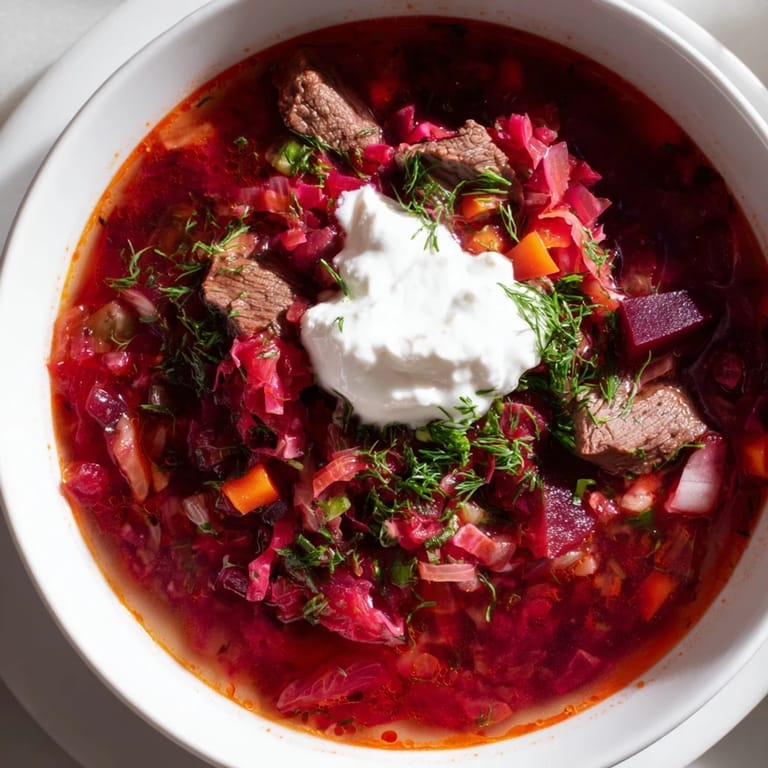
Save My grandmother's kitchen always smelled like earth and vinegar when she made borscht, the kind of soup that turns the whole house deep crimson as it simmers. I watched her grate beets with such practiced ease, her fingertips stained magenta, never rushing even when we had hungry cousins waiting at the table. There's something almost meditative about building this soup, layer by layer, letting the broth absorb each vegetable's personality before moving to the next. It's not just food—it's a conversation between ingredients that took me years to understand.
I made this for my roommate on her first really bad day in a new city, and she cried a little when she tasted it—not because it was sad, but because it tasted like home, even though it wasn't hers. That's when I realized borscht has this quiet power to make anyone feel tended to, like someone spent time thinking about feeding them properly.
Ingredients
- Beef chuck or brisket, 400g: These tough cuts become impossibly tender after simmering in broth, and they flavor the entire pot with deep, savory richness that you can't fake with anything else.
- Water, 1.5 liters: Don't skimp on the amount—the broth needs space to become something meaningful during those 45 minutes.
- Bay leaves and black peppercorns: These aren't just seasoning; they're the backbone that keeps everything tasting balanced and not one-note.
- Beets, 3 medium: Grate these fresh, not from a jar—the raw beet's earthy sweetness transforms completely when it hits the hot oil and sautés.
- Carrots, 2 medium: Grating them gives the soup a silky texture that whole pieces never quite achieve, and they cook down to almost nothing, melting into sweetness.
- Onion, 1 medium: Cooking it in oil until it's just translucent is the difference between soup that tastes raw and soup that tastes like someone cared.
- Potatoes, 2 medium: These need to be diced small enough to soften in 10 minutes but large enough that you can still taste them as distinct pieces.
- Green cabbage, 1/4 small head: Shred it by hand if you have patience—the texture stays better than if you chop it, and it holds the broth's flavor without disappearing.
- Tomato paste, 2 tablespoons: This is what gives borscht its depth; don't skip it or replace it with tomato sauce, which has too much liquid.
- Garlic, 2 cloves: Add it near the end so it stays bright and garlicky, not mushy and bitter from hours of cooking.
- Sunflower oil, 2 tablespoons: Use something neutral and light—olive oil tastes wrong in Ukrainian borscht, and butter can make it feel too rich.
- Sugar, 1 tablespoon: A small amount tames the earthiness of the beets and brings out their natural sweetness without making anything taste sugary.
- White vinegar, 2 tablespoons: This is essential—it brightens everything and prevents the soup from tasting flat and one-dimensional.
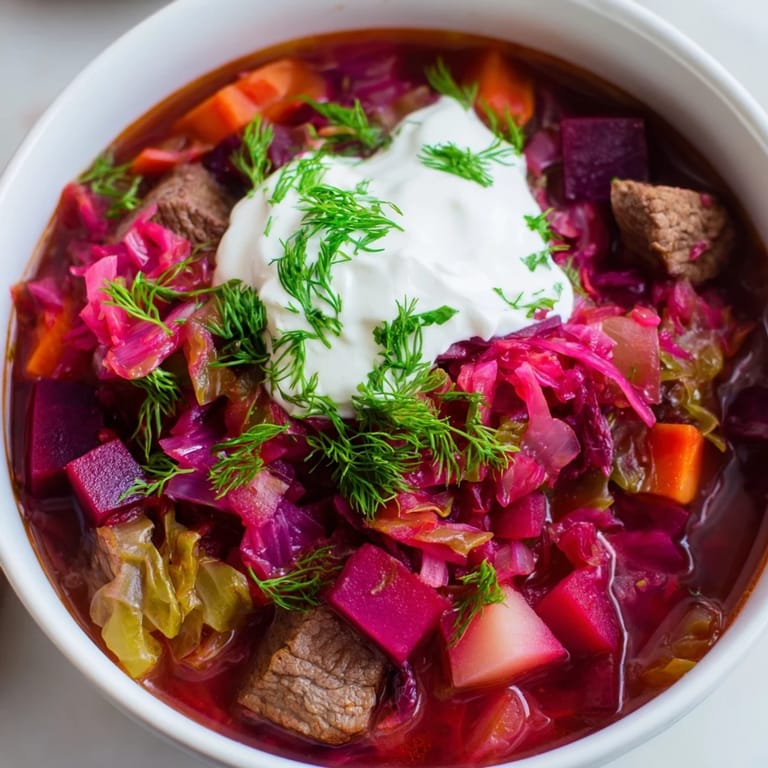
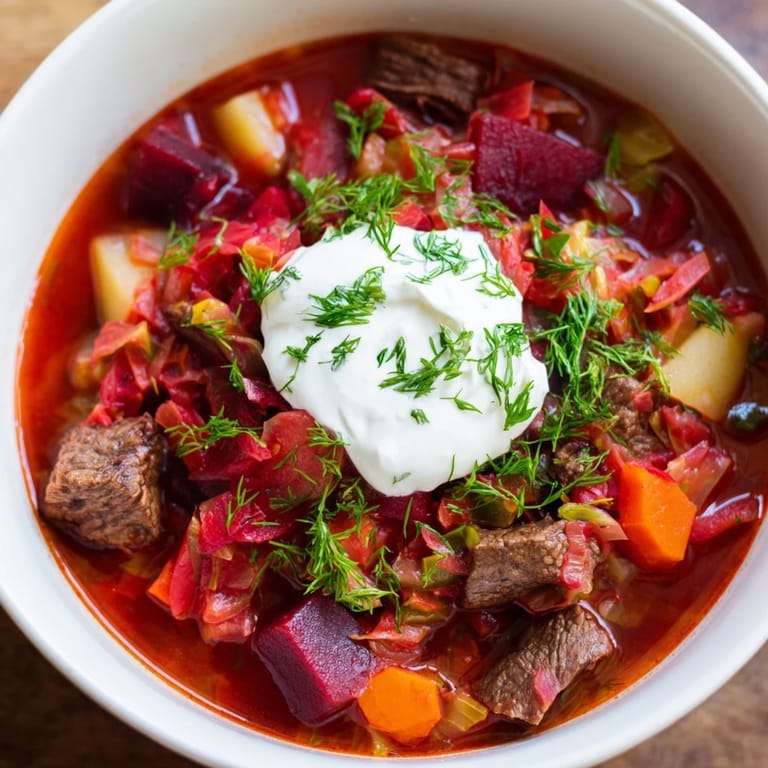
- Sour cream, 150g: The dollop at the end isn't decoration; it's where the temperature and acidity of the soup meet the cool creaminess and create something transcendent.
- Fresh dill or parsley: Dill is traditional and tastes more like Ukraine; parsley is brighter if you prefer that direction.
Tired of Takeout? 🥡
Get 10 meals you can make faster than delivery arrives. Seriously.
One email. No spam. Unsubscribe anytime.
Instructions
- Set the broth foundation:
- Combine your beef pieces, water, bay leaves, peppercorns, and salt in a large pot and bring to a rolling boil. You'll see gray foam rise to the surface—skim it off with a spoon because that's impurities, and you want clear broth, not cloudy. Once it's clean, reduce the heat and let it simmer gently for 45 minutes; the meat should be tender enough to break apart with a wooden spoon.
- Build flavor in the skillet:
- While the broth works, heat your oil in a skillet over medium heat and add the chopped onion, letting it turn translucent and soft without browning. Add your grated carrots and beets to the same skillet and let them sauté for 5 minutes, watching as they soften and start releasing their color into the oil. Stir in the tomato paste, sugar, and vinegar—the mixture will smell almost sweet and tangy, which is exactly right—and cook for another 7 to 8 minutes until everything is tender and melded.
- Combine broth and vegetables:
- Remove the cooked beef from the pot (you can shred it now or later, your choice) and add your diced potatoes directly to the simmering broth. After 10 minutes, when the potatoes have started to soften, pour in all that sautéed beet mixture from the skillet, scraping every bit of it into the pot.
- Finish and rest:
- Add your shredded or cubed beef back to the pot along with the minced garlic, tasting as you go and adjusting salt and pepper until it sings. Let the whole thing simmer for 5 more minutes so the garlic loses its rawness, then remove it from heat and let it sit undisturbed for 15 to 20 minutes—this rest time is when the flavors settle and deepen into something almost unrecognizable from what you started with.
 Save
Save I've learned that borscht is one of those dishes that teaches you patience without lecturing you about it. Every time I make it, I remember that good food doesn't rush.
The Story Behind Ukrainian Borscht
Borscht appears on tables across Eastern Europe, but the Ukrainian version is recognizably its own thing—earthier, deeper, with that sour cream finish that feels less like a garnish and more like the dish's whole point. It's been feeding people through winters for generations, the kind of soup that made sense when fresh vegetables weren't available year-round and you had to work with what you'd stored in the root cellar. The tartness from vinegar and the richness from sour cream balance the earthiness of beets in a way that feels almost mathematically perfect.
Why This Soup Tastes Better the Next Day
There's a real reason borscht improves with time, and it's not just a saying—the broth continues to extract flavor from the beef and vegetables even as it cools and sits. The acidity of the vinegar gradually softens the earthiness of the beets into something smoother and less sharp, and the sour cream's tang becomes less of a jolt and more of an integral part of the whole thing. If you make it today and eat it tomorrow, you're tasting it at its peak.
Making It Your Own
The beauty of borscht is that it's forgiving enough to adapt to what you have and what you love. Some families add mushrooms or beans, others use pork instead of beef, and there's nothing wrong with any of that—the foundation is so strong that these changes work.
- For a vegetarian version, use vegetable broth and let the beets and tomato paste carry all the depth that the beef would have provided.
- Try a splash of lemon juice instead of vinegar if you want brightness without the tangy bite, though vinegar is traditional for a reason.
- Serve it with rye bread or pampushky (Ukrainian garlic rolls) to turn it into a complete meal that fills you all the way through.
 Save
Save Borscht is the kind of dish that asks you to slow down and trust the process, and it rewards that patience with something genuinely nourishing. Make it for someone you care about, or make it for yourself on a day when you need to know that you're worth the time.
Recipe Questions & Answers
- → What cut of beef works best for this borscht?
Chuck or brisket are preferred for their tenderness and flavor after slow simmering, ideal for creating a rich broth.
- → Can I prepare this dish without meat?
Yes, omitting beef and using vegetable broth creates a flavorful vegetarian variation while keeping the vibrant vegetable medley.
- → How long should the soup simmer for best results?
Simmer the beef gently for about 45 minutes, followed by additional cooking steps to fully soften vegetables and develop rich flavors.
- → What garnishes complement the flavors?
A dollop of sour cream and freshly chopped dill or parsley enhance the soup’s creamy and herbal notes beautifully.
- → Is this suitable for gluten-sensitive diets?
Yes, the soup is naturally gluten-free if served without bread. Check sour cream and tomato paste labels for any gluten content.